
TECHNOLOGY
Technical Principles
Independent Temperature Control at the Nozzle · Dynamic Variable-Temperature Patented Technology
Two-Stage Dynamic Temperature Control
Nozzle heating phase (before injection)
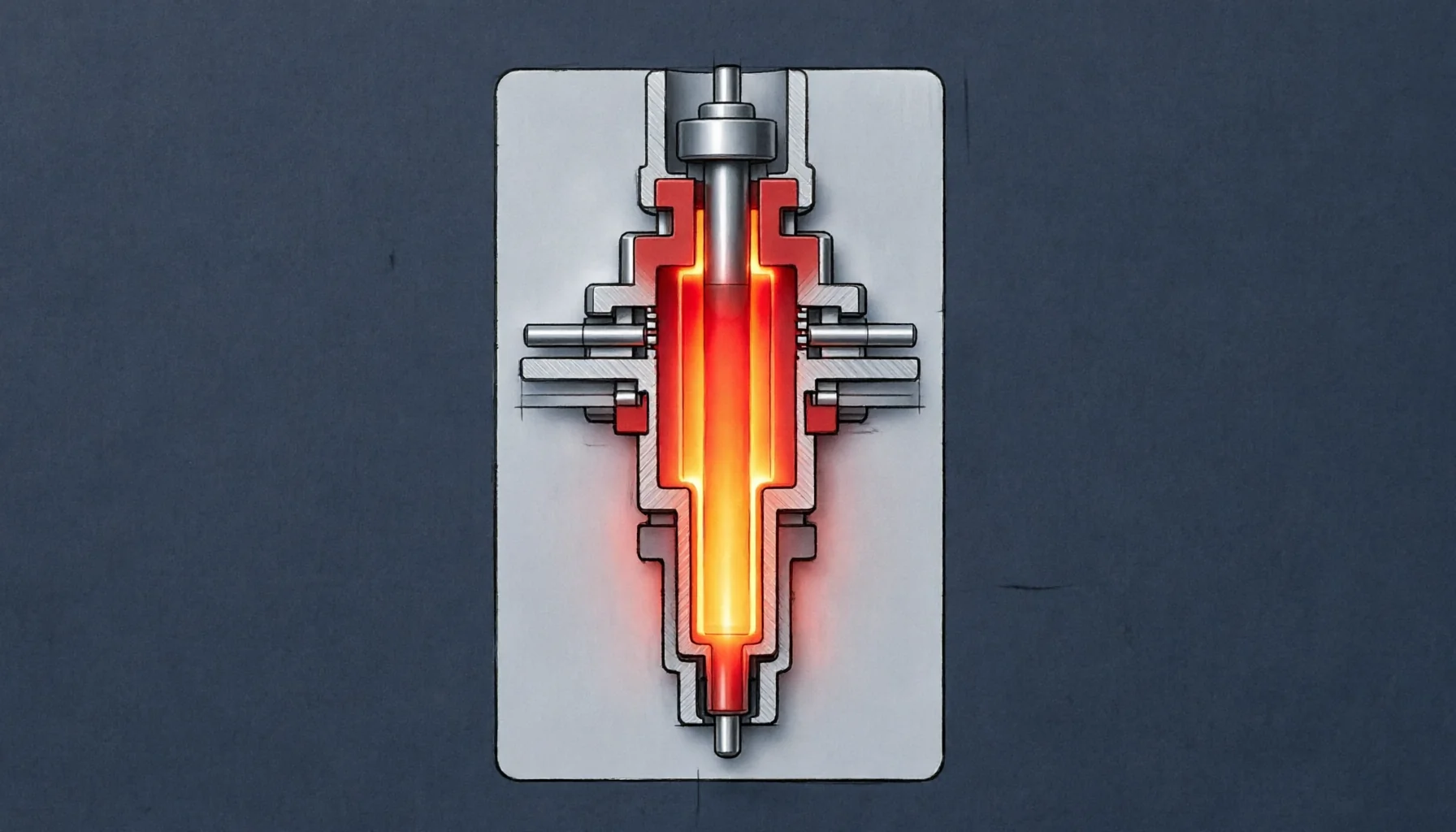
Before injection molding, the independent heating module at the hot nozzle tip precisely heats the gate material, equalizing temperatures between the gate and runner to eliminate local thermal gradients. This prevents cold slugs and poor weld lines, stabilizes melt flow, and ensures part quality and dimensional stability.
Nozzle cooling stage (after holding pressure)
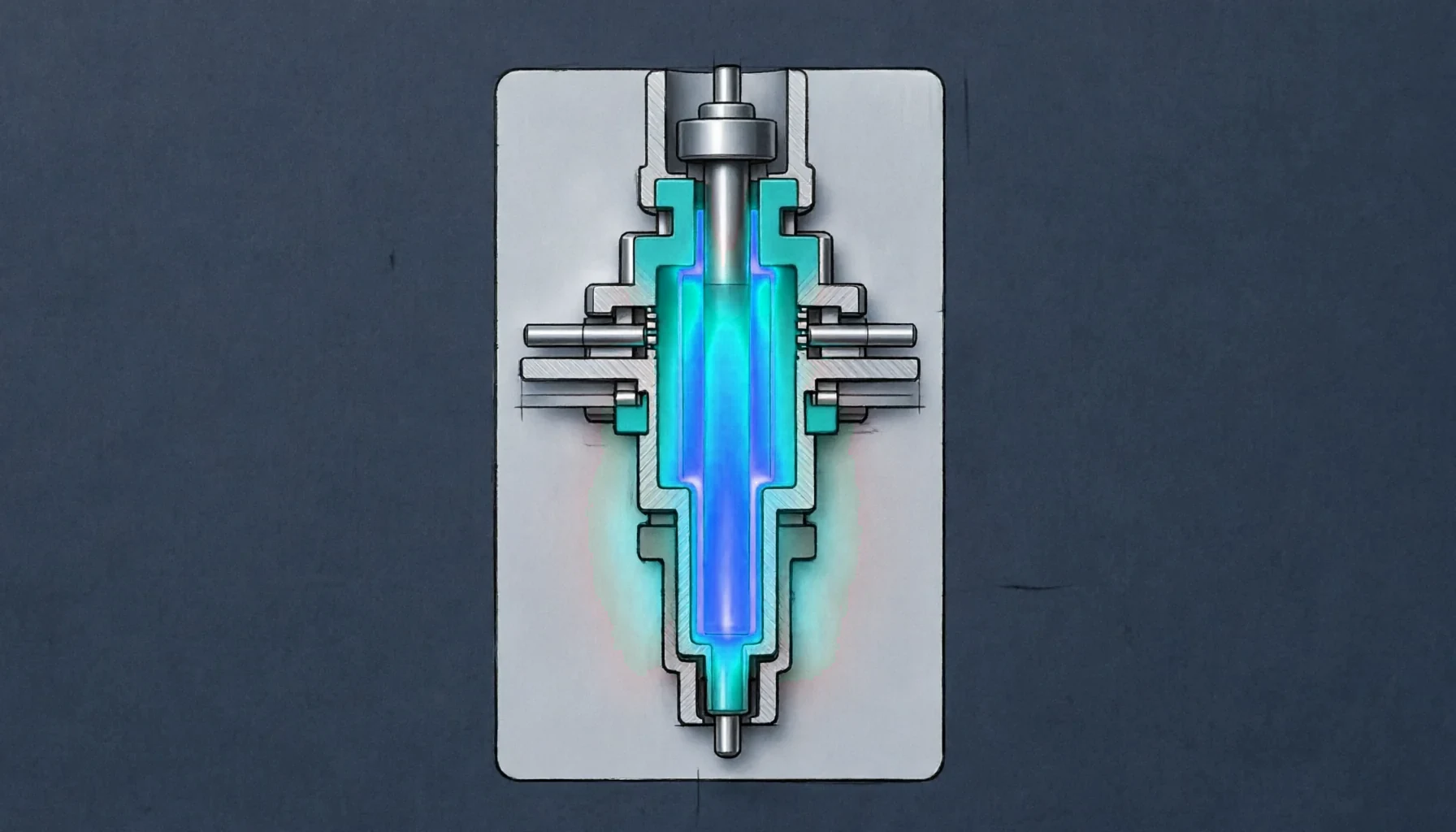
After injection holding and sealing are complete, the system automatically switches to nozzle cooling mode. Using a PID-enhanced algorithm combined with rated power cooling principles, it precisely lowers the temperature of the nozzle, gate, and valve pin contact surfaces. This accelerates resin cooling and solidification, improves gate appearance, reduces valve pin sticking and carbon buildup, and enhances equipment stability and component lifespan.
Temperature Curve Comparison
Passive Constant Temperature vs. Active Dynamic Temperature Control
Standard Hot Runner · Injection Cycle Temperature Curve (Passive恒温)
Temperature remains constant throughout the entire cycle, preventing gate state adjustments across process stages.
Hot/Cold Rapid Hot-Cold Runner · Injection Cycle Temperature Curve (Active Dynamic Variable-Temperature)
Pre-injection heating → High temperature during holding → Cooling during cooling → Pre-mold-opening heating: Temperature actively adjusts to each process stage.
Why can the vented structure prevent clogging?
Four structural designs eliminate melt stagnation and carbonization at the source.
Patent sealing structure
For highly corrosive, high-glass-fiber plastics (PA46, PA9T, PA10T, conductive rubber, etc.), ensures the nozzle resists corrosion and prevents leakage.
Flow channel corner radius transition
Seamless, residue-free, reduced pressure, improved balance, and minimized product stress.
Low-friction thermal design
Reduce pressure drop and friction heat, minimizing the risk of thermal degradation in heat-sensitive plastics.
Hot nozzle face flush against the splitter plate
Patent-designed structure eliminates mold machining errors and prevents glue leakage or seepage.
Patented needle guide pre-positioning
| Comparison Items | Traditional needle valve | Anmi rapid thermal shock needle valve |
|---|---|---|
| Navigation Structure | The valve needle guide ring is internal and located far from the gate. | Valve pin guide positioned upfront for direct gate entry |
| Material buildup risk | Guide ring accumulates residue → yellow/black spots | Effectively prevents material buildup and reduces yellowing or black spots. |
| Guidance Accuracy | Low guidance accuracy → Flash / burrs | Precision-guided, superior gate appearance. |
| Mouthpiece Material | The thermal material is too soft and lacks abrasion resistance. | High-hardness alloy steel nozzle tip, wear- and corrosion-resistant |
| Service Life | Gate life limited | Significantly extend mold gate life |
The through-nozzle solution adapts to over 90% of precision plastic parts, meeting quality standards without requiring a valve gate; the valve-gate option serves as an upgrade for high-end cosmetic components.
Needle Guide Prefixed · Structural Diagram
Traditional needle valve
The guide ring is located internally, far from the gate.
Anmi rapid thermal shock needle valve
Guide first, then enter the gate directly.
Tech Explainer Column
Anmi Hot Runner Knowledge Series: Browse article images using the left image slider; view the outline on the right. More technical articles will be added regularly.
In injection molding for precision connectors, LCP high-temperature materials, and glass fiber-reinforced modified compounds, poor part quality often stems from differences in temperature control logic within hot runner systems. Traditional constant-temperature hot runners and heat-up/cool-down hot runners represent distinct control philosophies with specific application boundaries; neither is inherently superior. This article provides an objective comparison based on underlying principles to guide hot runner selection for precision injection molding applications.
Overview: Root cause of the defect lies in differences in temperature control logic.
In molding precision connectors, LCP, and glass-fiber-reinforced modified materials, defects often stem from hot runner temperature control logic. Each technical approach has its own applicable boundaries.
Traditional constant-temperature hot runner: Consistently high temperature throughout the process.
Advantages: Low cost, compatible with common plastics like ABS and PP, and easy to operate. Limitations: The gate remains at high molten temperatures for extended periods, leading to carbonization, buildup, and residue adhesion; this causes stringing and sagging after mold opening and compromises dimensional stability.
Hot-cold hot-cold runner: Staged dynamic temperature control
Rapid heating during injection ensures mold filling; constant temperature and stable pressure during holding compensate for shrinkage; precise, rapid cooling at the gate during ejection solidifies and seals the part. This represents a proactive approach to eliminating molding defects.
Technical Advantages and Operating Conditions
Eliminates fiber streaking and gel strands, significantly reduces nozzle clogging from carbonization, ensures consistent temperature per cycle with closed-loop control, and minimizes reliance on operator expertise. Requires specific cooling conditions; system complexity and cost are higher than constant-temperature solutions.
Comparison of Underlying Logic and Use Cases
Constant temperature = passive remediation, suitable for general-purpose plastics and low-cost, low-precision products. Rapid heating and cooling = active solution, ideal for precision connectors, high-temperature engineering plastics, materials prone to carbonization or stringing, and thin-wall, high-precision molded parts.
Conclusion and Selection Recommendations
Summary: Choose constant temperature for standard materials and low-cost applications; opt for rapid heating and cooling for precision materials and high-temperature components. For precision connectors and high-temperature engineering plastics, we recommend prioritizing the evaluation of hot runner systems with rapid heating and cooling.